

What healthcare software has to get right
In healthcare, the data matters more than the screens. A patient record has to be accurate, available to the right people and closed to everyone else. That drives our design: access by role, an audit trail for every view and edit, and encryption in transit and at rest.
We build to support HIPAA requirements. That means the architecture gives you the controls an audit would look for. It does not mean certification, which belongs to your organization and your hosting setup, and we say so up front.
Standards first: FHIR and Medplum
Hospitals run many systems: labs, imaging, billing, pharmacy. FHIR is the standard that lets them exchange records in a common shape. When we build on FHIR, adding a lab feed or a partner app later becomes an integration, not a rewrite.
We have worked with Medplum, an open-source FHIR platform, and we use platforms like it where they fit, so you spend budget on your workflows rather than on rebuilding storage and APIs. Connections to other systems follow the patterns in our API integration and cloud work.
OpenEMR implementation for your practice
OpenEMR is a widely used open-source EMR and practice management system with no license fee. We install it in-house or in the cloud and customize it for the way your practice works: patient demographics, scheduling and reminders, charting, labs and lab interfaces, e-prescriptions, clinical decision rules, a patient portal, reports, billing codes such as ICD-10, more than one language and telehealth. You get the system and a team that supports it.
A dashboard framework for pharmacy groups
For groups that run several pharmacies, we have a framework for one web dashboard that brings them together: data collected from each site, KPIs and live progress updates, budget against actual spend, documents, resources and compliance reports, with role-based access for each stakeholder and Microsoft Project for schedules and the critical path. It is a starting design, not an off-the-shelf product. We shape it around your sites in phases:
- Requirements (4 to 6 weeks): the KPIs you track, the systems that hold the data and who sees what.
- Design (6 to 8 weeks): screens, the data model and any links to EHR, accounting or payment systems.
- Build and test (12 to 16 weeks).
- Data integration (4 to 6 weeks).
- Training and go-live (2 to 4 weeks), then support and improvements as you use it.
Patient apps, telehealth and room TVs
- Patient app. Booking, reminders, results and messages on iOS and Android, built by our mobile app development team.
- Telehealth. Video visits that open from a link, with a waiting room and visit notes saved to the chart.
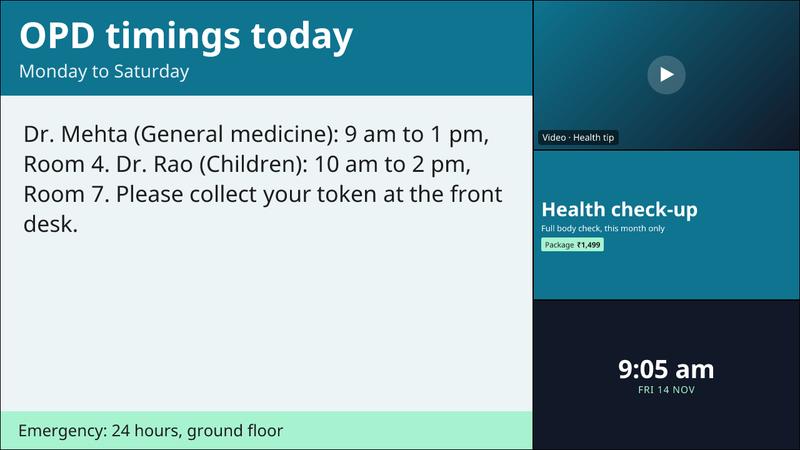
- Hospital IPTV. Welcome screens, education videos and entertainment on patient room TVs. It is the same platform we run for hotels; read about our hotel and hospital IPTV solution.
- AI support. Summaries of long notes and triage suggestions, always for clinician review. Our AI and ML development team builds and tests these with clinicians in the loop.
Why Total VDO for healthcare software
We combine two skills that rarely sit together: standards-based health data work and years of video and TV delivery. That is why telehealth and patient-room TV are handled by one team. You own the code, we sign an NDA before we see any data, and we work from test data until your own security review is complete. Tell us your setting and size and we will recommend what to build first.
Every project starts with a scoping call on your setting, users and data. We map the records you hold, the systems you must connect to and the controls your security team expects. Then we agree a first release, usually one clinical workflow done well, before widening the platform to more departments.